Peptides UK | Peptide Knowledge Hub
Cells within living organisms constantly exchange information. This communication allows biological systems to coordinate processes such as metabolism, growth, development and responses to changes in their environment.
One important way cells communicate is through molecules known as peptides, which can act as chemical messengers.
But how do cells recognise these messages?
The answer often involves specialised proteins called peptide receptors.
In this guide, Peptides UK explains what peptide receptors are, how they interact with signalling molecules, the different types of receptors and why receptor research is important in molecular biology and biotechnology.
What Are Peptide Receptors?
Peptide receptors are proteins that recognise and bind particular peptide molecules.
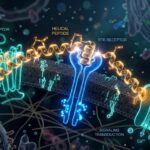
Many peptide receptors are located within the cell membrane, where they detect chemical signals outside the cell.
When a compatible peptide binds to a receptor, the interaction can change the receptor’s activity and initiate a response within the cell.
Peptides that bind to receptors are often referred to as ligands.
A ligand is a molecule that associates with a particular molecular target, such as a receptor.
The interaction between a peptide ligand and its receptor is an important mechanism of cellular communication.
However, not all peptides act through receptors, and not all receptors respond to peptides.
How Do Peptide Receptors Work?
Peptide receptors work through molecular recognition.
Each receptor has structural features that influence which molecules can bind to it.
A compatible peptide may associate with a particular region of the receptor, commonly called a binding site.
This interaction can alter the receptor’s three-dimensional structure or activity.
In many cases, the change initiates a biochemical signalling pathway.
A simplified explanation involves five stages:
- Peptide release: A signalling peptide is produced and released by a cell or tissue.
- Molecular recognition: The peptide encounters a compatible receptor.
- Receptor binding: Chemical interactions allow the peptide to bind.
- Signal transduction: Receptor activity influences molecular events inside the cell.
- Cellular response: The cell responds through changes in a particular biochemical process.
Not every receptor follows this exact sequence, but it illustrates a common signalling mechanism.
How Do Peptides Recognise Their Receptors?
Peptide-receptor recognition depends on the molecular properties of both the peptide and the receptor.
Several types of chemical interactions can contribute to binding.
Hydrogen Bonds
Hydrogen bonds help stabilise interactions between compatible chemical groups.
Electrostatic Interactions
Positively and negatively charged regions of molecules can attract one another, influencing receptor recognition.
Hydrophobic Interactions
Non-polar molecular regions can associate in ways that reduce their exposure to water.
Van der Waals Forces
These weak, short-range interactions contribute to molecular recognition when atoms are positioned close together.
Together, these interactions influence how a peptide binds to a receptor and how stable the resulting complex may be.
What Is Receptor Specificity?
Receptor specificity describes the tendency of a receptor to recognise certain molecules more readily than others.
A receptor’s binding site has a particular chemical environment and three-dimensional arrangement.
Peptides with compatible structural features may bind to that receptor.
However, receptor recognition is not always exclusive.
Some receptors can interact with multiple related ligands, and certain peptides may interact with more than one receptor.
This is why scientists study receptor selectivity rather than assuming every peptide interacts with only one molecular target.
What Are the Main Types of Peptide Receptors?
Peptide signalling involves several different classes of receptors.
Two particularly important categories are G protein-coupled receptors and enzyme-linked receptors.
1. G Protein-Coupled Receptors (GPCRs)
G protein-coupled receptors, commonly called GPCRs, are a large family of cell-surface proteins involved in biological signalling.
They typically contain seven membrane-spanning segments.
When activated by an appropriate ligand, a GPCR can influence intracellular signalling proteins known as G proteins.
These proteins may then regulate enzymes, ion channels or other signalling components.
Examples of peptide-related GPCR systems include:
- Glucagon receptors
- Glucagon-like peptide-1 (GLP-1) receptors
- Oxytocin receptors
- Vasopressin receptors
- Certain neuropeptide receptors
GPCRs are important subjects of molecular and pharmaceutical research.
2. Receptor Tyrosine Kinases
Receptor tyrosine kinases are another important group of cell-surface receptors.
These proteins contain intracellular regions with enzymatic activity.
When activated, they can initiate signalling through the phosphorylation of specific protein residues.
An important example is the insulin receptor.
Insulin is a peptide hormone, and its receptor belongs to the receptor tyrosine kinase family.
Insulin receptor signalling contributes to the regulation of glucose metabolism and other cellular processes.
3. Cytokine Receptors
Some peptide and protein signalling molecules interact with receptors associated with intracellular kinases.
These include certain cytokine receptor systems.
Unlike receptor tyrosine kinases, many cytokine receptors do not possess intrinsic kinase activity.
Instead, they rely on associated signalling proteins to transmit information.
These receptor systems participate in processes such as immune regulation and cellular growth.
What Happens Inside a Cell After Receptor Activation?
When a receptor responds to a peptide ligand, it may initiate a process called signal transduction.
Signal transduction is the conversion of a molecular signal into a series of intracellular events.
Depending on the receptor, these events may involve:
- Activation or inhibition of enzymes
- Changes in intracellular calcium concentrations
- Production of second messengers
- Protein phosphorylation
- Changes in gene expression
- Alterations in cellular metabolism
The resulting response depends on the receptor, cell type and surrounding biological conditions.
Importantly, binding to a receptor does not always mean the receptor will be activated.
Some ligands block receptor activation or produce different patterns of signalling.
What Are Second Messengers?
Second messengers are molecules or ions that transmit information within cells following receptor activation.
They help relay and sometimes amplify the original signal.
Examples include:
Cyclic AMP (cAMP): A signalling molecule involved in numerous intracellular pathways.
Calcium ions (Ca²⁺): Important regulators of many cellular activities.
Inositol trisphosphate (IP3): A signalling molecule that can contribute to the release of calcium from intracellular stores.
Diacylglycerol (DAG): A molecule involved in activating certain signalling proteins.
Not every peptide receptor uses these second messengers.
Different receptor families activate different intracellular mechanisms.
What Is the Difference Between an Agonist and an Antagonist?
Two important terms in receptor research are agonist and antagonist.
Agonists
An agonist is a molecule that binds to a receptor and activates it, producing a measurable receptor response.
Some naturally occurring peptide hormones act as agonists at their corresponding receptors.
Antagonists
An antagonist binds to a receptor and blocks or reduces activation by an agonist without activating the receptor in the same way.
Researchers study both agonists and antagonists to understand receptor behaviour.
Partial Agonists
Partial agonists activate receptors but produce a lower maximal response than full agonists in a given experimental system.
Biased Agonists
Some ligands preferentially activate certain signalling pathways associated with a receptor.
This phenomenon is known as biased agonism.
These concepts help scientists understand why different molecules can produce different responses through the same receptor.
What Is Receptor Binding Affinity?
Binding affinity describes the strength of the interaction between a ligand and its molecular target under defined conditions.
Scientists often investigate affinity using experimental binding assays.
One common measurement is the equilibrium dissociation constant, represented as Kd.
For a simple one-to-one binding interaction, a lower Kd generally indicates stronger binding affinity.
However, receptor affinity and biological activity are not identical.
A molecule may bind strongly to a receptor without producing a strong activating response.
This is why researchers distinguish between:
- Affinity: How strongly a ligand binds.
- Efficacy: How effectively a bound ligand produces a receptor response.
- Potency: The concentration required to produce a defined effect in a particular assay.
These measurements help researchers interpret receptor interactions more accurately.
Can One Peptide Interact With Multiple Receptors?
Yes.
Some peptides can interact with multiple receptor subtypes.
These interactions may differ in affinity, efficacy and downstream signalling.
For example, certain naturally occurring peptides belong to families whose members act at related receptors.
Scientists investigate these interactions to understand receptor selectivity and molecular signalling networks.
The presence of activity at multiple receptors does not, by itself, establish any particular therapeutic benefit or safety profile.
What Is Receptor Desensitisation?
Receptors do not always respond to repeated or sustained stimulation in the same way.
In some circumstances, prolonged exposure to a ligand can reduce receptor responsiveness.
This process is called receptor desensitisation.
Depending on the receptor system, desensitisation may involve:
- Receptor phosphorylation
- Recruitment of regulatory proteins
- Changes in receptor localisation
- Receptor internalisation
- Alterations in downstream signalling
Some receptors may later return to the cell surface or recover responsiveness.
Others may undergo degradation.
These mechanisms help cells regulate their responses to chemical signals.
How Do Scientists Study Peptide Receptors?
Researchers use a range of experimental techniques to investigate peptide-receptor interactions.
Receptor Binding Assays
Binding assays measure how ligands associate with particular receptors.
They can help researchers investigate binding affinity and selectivity.
Cell-Based Signalling Assays
These assays measure cellular responses following receptor activation or inhibition.
Depending on the system, researchers may measure cAMP, calcium signalling or other intracellular events.
Structural Biology
Techniques such as cryo-electron microscopy, X-ray crystallography and nuclear magnetic resonance spectroscopy can provide information about molecular structures.
Structural studies can help reveal how peptides interact with receptor binding sites.
Molecular Modelling
Computational methods may be used to explore possible peptide-receptor interactions.
However, computer-generated predictions require appropriate experimental validation.
Gene Expression Studies
Researchers may investigate which cells express particular receptors and how receptor expression changes under different experimental conditions.
Each technique contributes different information, and no single assay fully describes receptor function.
Why Are Peptide Receptors Important in Biotechnology?
Peptide receptor research contributes to several scientific disciplines.
These include:
- Molecular biology
- Cell biology
- Biochemistry
- Structural biology
- Pharmacology
- Biotechnology
- Drug discovery
- Analytical research
Understanding peptide-receptor interactions helps scientists investigate how biological signals are recognised and transmitted.
Receptor research also supports the development of experimental tools for studying cellular processes.
Some authorised medicines act on peptide-related receptor systems.
However, an experimental molecule’s ability to bind or activate a receptor does not establish that it is safe or effective for human use.
Frequently Asked Questions
What is a peptide receptor in simple terms?
A peptide receptor is a protein that recognises certain peptide molecules and may transmit signals that influence cellular activity.
Where are peptide receptors found?
Many peptide receptors are located in cell membranes, although peptide-related molecular interactions can also occur within cells.
Do all peptides bind to receptors?
No. Some peptides interact with enzymes, membranes or other molecular targets rather than receptors.
Are all peptide receptors GPCRs?
No. Although many peptide receptors are GPCRs, other peptide-related receptor systems include receptor tyrosine kinases and cytokine receptors.
What happens when a peptide binds to a receptor?
Binding may activate, inhibit or otherwise alter receptor activity, depending on the ligand and receptor involved.
What is the difference between receptor affinity and potency?
Affinity describes ligand binding strength, while potency describes the concentration needed to produce a defined response in a particular experimental system.
Can peptide receptors stop responding?
Yes. Some receptors undergo desensitisation or other regulatory changes following sustained or repeated stimulation.
Does receptor activation prove a peptide has medical benefits?
No. Receptor activity in laboratory experiments does not establish clinical safety, effectiveness or regulatory approval.
Conclusion: Understanding Peptide Receptors
Peptide receptors are important components of biological communication.
By recognising particular peptide molecules, these specialised proteins help cells detect signals and coordinate biochemical responses.
Different receptor families use different signalling mechanisms, and their behaviour depends on molecular structure, ligand properties and cellular conditions.
Understanding peptide receptors provides a foundation for studying molecular signalling, biotechnology and pharmaceutical research.
At Peptides UK, our Peptide Knowledge Hub is dedicated to explaining peptide science through accessible, research-focused educational articles.
Explore our other guides to learn more about peptide sequences, amino acids, molecular interactions and synthetic peptide manufacturing.
Research and Safety Disclaimer
This article is intended for general scientific and educational purposes only and does not constitute medical advice.
Experimental research peptides must not be assumed safe or effective for human use. Materials designated strictly for laboratory research are not approved for human consumption or clinical use. This does not imply that all peptide-based medicines are unapproved.