Peptides UK | Peptide Knowledge Hub
Synthetic peptides are an important part of modern biotechnology, supporting research in molecular biology, biochemistry, analytical chemistry and pharmaceutical development.
Unlike peptides extracted from natural biological sources, synthetic peptides are produced through controlled manufacturing processes that allow scientists to assemble specific amino acid sequences.
But how are synthetic peptides manufactured, and what steps are involved in transforming individual amino acids into a finished peptide suitable for laboratory investigation?
In this guide, Peptides UK explores the science behind synthetic peptide manufacturing, including solid-phase peptide synthesis (SPPS), purification, lyophilisation, analytical testing and quality control.
What Are Synthetic Peptides?
Synthetic peptides are molecules manufactured by chemically joining amino acids in a predetermined sequence.
Amino acids are the fundamental building blocks of peptides and proteins.
When two amino acids are connected through a peptide bond, they form a dipeptide. Additional amino acids can be added to produce longer peptide chains.
The sequence of amino acids influences the peptides chemical properties, molecular structure and potential biological activity.
Synthetic peptide manufacturing allows researchers to produce defined sequences for scientific investigation.
These peptides may be used in laboratory studies involving molecular interactions, receptor biology, analytical method development and other areas of biotechnology.
Why Are Peptides Manufactured Synthetically?
Although many peptides occur naturally in living organisms, obtaining them directly from biological sources can present challenges.
Natural extraction may involve complex purification procedures, limited yields or variability between samples.
Chemical synthesis provides an alternative method for producing specific amino acid sequences.
Potential advantages include:
- Control over the intended amino acid sequence
- The ability to investigate modified peptide structures
- Reproducible manufacturing processes when properly validated
- Production of peptides that are difficult to isolate naturally
- Support for analytical and molecular research
However, chemical synthesis does not automatically guarantee high purity or consistent quality.
The reliability of the final material depends on the manufacturing process, purification methods and analytical controls.
Step 1: Designing the Peptide Sequence
The manufacturing process begins with identifying the intended amino acid sequence.
Each amino acid has specific chemical characteristics that influence the resulting peptide.
Researchers consider factors such as:
- Amino acid composition
- Sequence length
- Molecular weight
- Solubility
- Chemical stability
- Potential structural features
- Intended laboratory application
Some peptides also contain chemical modifications, such as terminal modifications or non-standard amino acids.
These modifications may be investigated to understand their effects on molecular properties.
The design stage establishes the intended chemical identity of the final product.
Step 2: Selecting and Preparing Amino Acids
Once the sequence has been defined, the appropriate amino acid building blocks are selected.
During chemical synthesis, amino acids commonly contain temporary protecting groups.
These groups prevent unwanted chemical reactions at particular functional sites.
Protecting groups allow peptide bonds to form in a controlled manner while reducing unintended side reactions.
One commonly used strategy is based on Fmoc (9-fluorenylmethoxycarbonyl) chemistry.
Fmoc is a temporary protecting group used in many solid-phase peptide synthesis processes.
Other protecting-group strategies also exist, including Boc-based chemistry.
The choice of synthesis strategy depends on the peptide and the requirements of the manufacturing process.
Step 3: Solid-Phase Peptide Synthesis (SPPS)
One of the most widely used methods for manufacturing synthetic peptides is solid-phase peptide synthesis, commonly abbreviated to SPPS.
This approach was developed by chemist Robert Bruce Merrifield and became a major advancement in peptide chemistry.
In SPPS, a growing peptide chain is attached to an insoluble solid support, often referred to as a resin.
Amino acids are added sequentially to extend the chain.
The solid support makes it possible to separate the growing peptide from many reaction components through washing and filtration.
How Does SPPS Work?
At a conceptual level, SPPS involves several repeating stages.
1. Attachment to a Solid Support
The initial amino acid or an appropriate linker is attached to a solid support.
2. Removal of a Temporary Protecting Group
A protecting group is removed to expose a reactive site for the next amino acid addition.
3. Amino Acid Coupling
The next protected amino acid is chemically joined to the growing peptide chain.
4. Washing and Separation
Excess reagents and certain reaction by-products are removed while the peptide remains attached to the solid support.
5. Repetition
The process continues until the intended amino acid sequence has been assembled.
This is a simplified explanation of the manufacturing principle rather than an operational laboratory protocol.
Step 4: Peptide Cleavage and Deprotection
Once the desired sequence has been assembled, the peptide must be separated from the solid support.
This stage is known as cleavage.
Depending on the synthesis strategy, cleavage may also involve removing protecting groups from amino acid side chains.
The resulting material is commonly described as a crude peptide.
Crude peptides may contain the intended product alongside impurities formed during synthesis.
Examples of potential impurities include:
- Incomplete peptide sequences
- Deletion sequences
- Chemically modified peptide variants
- Residual synthesis-related compounds
- Other process-related by-products
The presence and quantity of these impurities depend on the sequence and manufacturing conditions.
Further purification is often required before the material is suitable for its intended analytical application.
Step 5: Purifying the Synthetic Peptide
Purification is an important stage in peptide manufacturing.
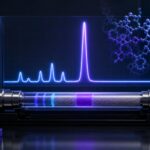
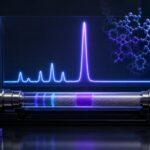
One widely used technique is preparative high-performance liquid chromatography (HPLC).
Preparative HPLC separates components of a mixture according to their interactions with a stationary phase and a moving liquid phase.
The target peptide can be collected in selected fractions, while some impurities are separated into different fractions.
What Is Reverse-Phase HPLC?
Reverse-phase HPLC is frequently used in peptide purification and analysis.
It commonly employs a relatively non-polar stationary phase and a more polar mobile phase.
Peptides and impurities interact differently with the chromatographic system, allowing separation under suitable conditions.
The effectiveness of purification depends on factors including peptide structure, sample composition and the selected analytical method.
Importantly, purification may require multiple stages, and no single technique guarantees the removal of every impurity.
Step 6: Confirming Peptide Identity
After purification, analytical testing is used to assess whether the resulting material corresponds to the intended peptide.
One commonly used technique is mass spectrometry.
Mass spectrometry measures the mass-to-charge ratios of ions and can provide information about molecular mass.
Comparing the observed molecular mass with the expected value can support peptide identification.
However, matching molecular mass alone does not always establish the complete amino acid sequence or distinguish between all possible structural variants.
Additional analytical techniques may be needed to confirm identity.
These can include specialised mass spectrometry methods, chromatographic comparisons and other structural characterisation techniques.
Step 7: Assessing Peptide Purity
Purity analysis is another important part of peptide manufacturing.
Analytical HPLC is frequently used to estimate the proportion of detected chromatographic components attributable to the target peptide.
Results may be reported as a percentage.
For example, a chromatographic report may indicate a purity value of 99%.
However, 99% HPLC purity does not necessarily mean that 99% of the entire sample mass consists of the intended peptide.
This distinction is important because HPLC area percentages depend on the analytical method and detector response.
Certain impurities, counterions, water or residual solvents may not be adequately represented by a particular chromatographic result.
Consequently, purity testing should be interpreted alongside other relevant analytical information.
A high reported purity also does not establish sterility, clinical safety or suitability for human administration.
Step 8: Lyophilisation (Freeze-Drying)
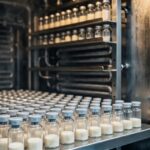
Some purified peptides are processed using a technique called lyophilisation.
Lyophilisation is a controlled freeze-drying process used to remove water or suitable solvents from a material.
At a general level, the process involves freezing the material and reducing pressure so that frozen solvent can be removed through sublimation.
Additional drying may reduce remaining moisture.
The resulting peptide may be supplied as a dry powder or porous solid.
Why Is Lyophilisation Used?
Lyophilisation can offer advantages for certain peptide formulations, including:
- Reduced moisture content
- Improved stability for some materials
- Easier handling and transportation in certain circumstances
- Support for controlled storage conditions
However, not all peptides benefit equally from freeze-drying.
The success of lyophilisation depends on the molecular characteristics of the peptide and the formulation and process used.
Freeze-drying does not, by itself, establish sterility.
Step 9: Quality Control and Documentation
Quality control is essential for assessing whether a manufactured peptide meets defined specifications.
Depending on its intended use, testing may include:
- Identity analysis
- Chromatographic purity
- Molecular mass confirmation
- Water content
- Residual solvent analysis
- Counterion content
- Appearance and physical characteristics
- Stability assessment
Additional tests may be necessary for particular applications.
For example, materials intended for pharmaceutical use may require substantially more extensive controls than those intended solely for non-clinical laboratory research.
What Is a Certificate of Analysis?
A Certificate of Analysis (COA) documents specified analytical results for a particular product or batch.
A COA may include the product identity, batch number, test methods, results and acceptance criteria.
The document helps researchers understand what has been tested and which specifications have been assessed.
However, a COA is only as informative as the underlying analytical methods and testing programme.
It should not be interpreted as proof of clinical safety or regulatory approval.
Step 10: Packaging and Storage
Following manufacturing and quality assessment, peptide materials may be packaged for their intended application.
Packaging decisions depend on the chemical properties of the peptide, the required storage conditions and the intended distribution process.
Factors that may affect peptide stability include:
- Temperature
- Moisture
- Oxygen exposure
- Light exposure
- pH
- Molecular structure
- Formulation
Appropriate packaging and storage procedures are determined using substance-specific information.
There is no single storage condition that is suitable for every synthetic peptide.
Are All Synthetic Peptides Manufactured Using SPPS?
No.
Although SPPS is widely used, it is not the only approach to peptide production.
Other methods include:
Solution-Phase Peptide Synthesis
Solution-phase synthesis involves peptide-forming reactions carried out in solution rather than on a solid support.
It can be useful for certain sequences, fragments or manufacturing strategies.
Hybrid Synthesis
Hybrid methods combine different synthetic approaches, sometimes joining separately manufactured peptide fragments.
Recombinant Production
Certain peptides and polypeptides can be produced using engineered biological expression systems.
The most appropriate manufacturing method depends on factors such as peptide length, sequence complexity, desired modifications and production scale.
What Challenges Are Involved in Synthetic Peptide Manufacturing?
Peptide synthesis can present several technical challenges.
Incomplete Coupling
Not every amino acid addition proceeds to completion, potentially generating shorter or incorrect sequences.
Side Reactions
Chemical reactions may produce unintended modifications or by-products.
Difficult Sequences
Some amino acid sequences can be challenging to synthesise because of aggregation, steric effects or chemical instability.
Purification Complexity
Peptide impurities may have chemical properties similar to the intended product, making separation difficult.
Manufacturing Consistency
Reproducible production requires appropriate process controls, analytical methods and documentation.
These challenges explain why manufacturing quality cannot be assessed solely from the appearance of a peptide sample.
Why Is Synthetic Peptide Manufacturing Important in Biotechnology?
Synthetic peptide manufacturing supports a wide range of scientific activities.
Researchers use synthetic peptides in:
- Molecular biology
- Receptor binding studies
- Analytical method development
- Structural biology
- Biochemical assays
- Protein interaction studies
- Pharmaceutical research
- Biotechnology development
The ability to manufacture defined amino acid sequences helps scientists investigate how molecular structure influences chemical and biological behaviour.
Nevertheless, a peptides successful synthesis does not establish that it is safe or effective for clinical use.
Frequently Asked Questions
How are synthetic peptides made?
Synthetic peptides are commonly manufactured by chemically joining amino acids in a predetermined sequence. Solid-phase peptide synthesis is one widely used method.
What does SPPS stand for?
SPPS stands for solid-phase peptide synthesis, a technique in which a peptide chain is assembled while attached to a solid support.
Are synthetic peptides the same as natural peptides?
A synthetic peptide can have the same amino acid sequence and chemical structure as a naturally occurring peptide. However, manufacturing-related impurities, modifications and formulation characteristics may differ.
What is peptide purification?
Peptide purification is the process of separating the intended peptide from unwanted components produced during manufacturing.
Why is HPLC used in peptide manufacturing?
HPLC can be used to separate peptide mixtures and assess chromatographic purity.
Does 99% purity mean a peptide is pharmaceutical grade?
No. A reported purity percentage does not, by itself, demonstrate compliance with pharmaceutical manufacturing standards or establish suitability for human use.
What is a lyophilised peptide?
A lyophilised peptide is a peptide preparation that has undergone freeze-drying to remove water or other suitable solvents under controlled conditions.
Are all synthetic peptides approved for human use?
No. Some peptide-based medicines are authorised for specific clinical uses, while many synthetic peptides remain experimental research materials.
Conclusion: Understanding Synthetic Peptide Manufacturing
Synthetic peptide manufacturing is a specialised area of biotechnology that combines organic chemistry, analytical science and quality control.
From designing an amino acid sequence to chemical synthesis, purification, identity confirmation and stability assessment, each stage contributes to understanding the final material.
Techniques such as solid-phase peptide synthesis, HPLC and mass spectrometry have become important tools in modern peptide research.
At Peptides UK, our Peptide Knowledge Hub aims to make these scientific processes easier to understand through clear, accessible and research-focused educational content.
Explore our other guides to learn more about amino acids, peptide structure, molecular signalling and analytical testing.
Research and Safety Disclaimer
This article is provided for general scientific and educational purposes only. It does not constitute medical advice or an operational manufacturing protocol.
Experimental research peptides must not be assumed safe or effective for human use. Materials designated strictly for laboratory research are not approved for human consumption or clinical use. This does not imply that all synthetic peptides or peptide-based medicines lack regulatory approval.