Peptides UK | Peptide Knowledge Hub
Peptides play an important role in many biological processes, from communication between cells to the regulation of complex biochemical pathways. But how do peptides work at the molecular level, and what allows these small chains of amino acids to interact with biological systems?
The answer lies in their molecular structure, chemical properties and interactions with other molecules.
In this guide, Peptides UK explores the fascinating science behind peptide activity, including amino acid sequences, receptor binding, cellular signalling and the molecular mechanisms that researchers investigate in laboratories.
What Are Peptides?
Peptides are molecules made from two or more amino acids connected by chemical bonds known as peptide bonds.
Amino acids are organic compounds that serve as the building blocks of peptides and proteins.
When amino acids join together, they form chains with specific sequences. These sequences influence the chemical properties, structure and potential biological activity of the resulting peptide.
Peptides occur naturally in living organisms and can also be synthesised in laboratories for scientific investigation.
For a more detailed introduction, read our related article: What Are Peptides? A Beginner’s Guide.
Understanding Peptide Structure at the Molecular Level
To understand how peptides work, it is important to examine their molecular structure.
Each amino acid contains a central carbon atom attached to an amino group, a carboxyl group, a hydrogen atom and a variable side chain.
The side chain, commonly called the R group, gives each amino acid its distinctive chemical characteristics.
Some amino acids have electrically charged side chains, while others are polar, non-polar or aromatic.
These differences influence how peptide molecules interact with their surroundings.
The Importance of Amino Acid Sequences
The order of amino acids within a peptide is known as its primary structure.
Even small changes to this sequence can affect:
- Molecular shape and flexibility
- Electrical charge
- Solubility
- Chemical stability
- Interactions with receptors or other molecules
- Biological activity
A peptide’s sequence is therefore an important factor in determining its molecular behaviour.
However, sequence alone does not fully explain peptide function. Environmental conditions and molecular structure also influence how peptides behave.
What Are Peptide Bonds?
Peptide bonds are covalent chemical bonds connecting amino acids.
They form between the carboxyl group of one amino acid and the amino group of another.
During peptide bond formation, a molecule of water is released.
The resulting bond creates part of the backbone of the peptide chain.
Peptide bonds have partial double-bond character, which restricts rotation around the bond and influences the shapes that peptide chains can adopt.
This structural feature is important because molecular shape can affect how peptides interact with other biological molecules.
How Do Peptides Interact With Cells?
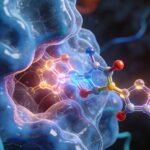
Many biologically active peptides interact with cells by binding to specific molecular targets.
One common type of target is a cellular receptor.
Receptors are proteins that recognise and respond to particular molecules, including certain peptide hormones and signalling compounds.
When a compatible peptide binds to a receptor, the interaction may trigger changes in receptor activity.
These changes can initiate biochemical events inside the cell.
However, not all peptides act through cell-surface receptors. Some interact with enzymes, membranes or other molecular structures.
Understanding Peptide-Receptor Binding
Peptide-receptor interactions are often highly selective.
This selectivity depends on the molecular characteristics of both the peptide and the receptor.
Several types of chemical interactions can contribute to binding.
1. Hydrogen Bonds
Hydrogen bonds are relatively weak interactions that help stabilise the association between molecules.
They can contribute to the recognition of specific peptide structures.
2. Electrostatic Interactions
Electrostatic interactions occur between electrically charged or partially charged regions of molecules.
Positively and negatively charged amino acid side chains can contribute to receptor binding.
3. Hydrophobic Interactions
Hydrophobic regions tend to associate in ways that reduce their exposure to water.
These interactions can help stabilise peptide binding within certain molecular environments.
4. Van der Waals Interactions
Van der Waals forces are weak, short-range interactions that contribute to molecular recognition and binding.
Together, these forces help determine how strongly and selectively a peptide associates with a molecular target.
What Happens When a Peptide Binds to a Receptor?
When a signalling peptide binds to a compatible receptor, it may cause a change in the receptor’s three-dimensional structure.
This is known as a conformational change.
Depending on the receptor and peptide involved, this change can activate or inhibit cellular signalling pathways.
A simplified example of peptide signalling involves five stages:
- Recognition: A peptide encounters a compatible receptor.
- Binding: Molecular interactions allow the peptide to associate with the receptor.
- Receptor response: Binding changes receptor activity.
- Signal transduction: Molecular events transmit information within the cell.
- Cellular response: The cell changes a particular biochemical or physiological process.
Not every peptide-receptor interaction follows this exact sequence, but it provides a useful introduction to molecular signalling.
What Is Cellular Signal Transduction?
Signal transduction describes the process through which cells convert molecular signals into biological responses.
Some peptide receptors activate intracellular proteins or enzymes that generate molecules known as second messengers.
Second messengers transmit information within the cell and can amplify or regulate the original signal.
Examples include:
- Cyclic adenosine monophosphate (cAMP)
- Calcium ions (Ca²⁺)
- Inositol trisphosphate (IP3)
- Diacylglycerol (DAG)
These molecules participate in signalling networks that regulate different aspects of cellular activity.
The particular pathway activated depends on the receptor, cell type and surrounding biological conditions.
G Protein-Coupled Receptors and Peptide Signalling
One important family of cellular receptors is known as G protein-coupled receptors, or GPCRs.
GPCRs are membrane proteins involved in detecting many types of extracellular signals.
Certain peptide hormones bind to specific GPCRs, triggering signalling pathways inside cells.
For example, receptors associated with glucagon-like peptide-1 (GLP-1) and glucagon are members of the GPCR family.
When activated by suitable ligands, these receptors can influence intracellular signalling systems.
However, receptor activation does not automatically translate into a particular clinical outcome. Biological effects depend on numerous factors and require appropriate experimental investigation.
How Does Molecular Shape Affect Peptide Activity?
Molecular shape is a key factor in peptide interactions.
Peptides are not always straight chains. Depending on their amino acid sequences and surrounding conditions, they may adopt different three-dimensional structures.
These can include:
- Alpha-helical structures
- Beta-turns
- Extended chain conformations
- Flexible or disordered structures
- Cyclic structures
Some peptides change shape as they interact with other molecules.
The relationship between molecular structure and biological activity is an important area of scientific investigation.
Researchers often refer to this as a structure–activity relationship, or SAR.
How Do Scientists Study Peptide Activity?
Laboratories use a variety of analytical and experimental techniques to investigate peptide behaviour.
High-Performance Liquid Chromatography (HPLC)
HPLC separates components within a sample and can be used to investigate peptide purity and chemical composition.
It does not, by itself, establish biological activity.
Mass Spectrometry
Mass spectrometry helps determine molecular mass and can support peptide identification.
Certain mass spectrometry methods can also provide information about amino acid sequences.
Receptor Binding Assays
Receptor binding assays investigate how molecules associate with particular receptors.
They can provide information about binding affinity and selectivity.
Cell-Based Assays
Cell-based assays allow researchers to investigate biological responses in controlled experimental systems.
Depending on the assay, researchers may measure changes in signalling molecules, enzyme activity or gene expression.
Structural Analysis
Techniques such as nuclear magnetic resonance (NMR) spectroscopy, X-ray crystallography and cryo-electron microscopy can provide information about molecular structure and interactions.
Each technique answers different scientific questions and has its own limitations.
What Determines Peptide Stability?
Peptide stability refers to how well a peptide maintains its chemical structure and properties over time.
Several factors can influence stability, including:
- Temperature
- Moisture
- Light exposure
- pH
- Oxidation
- Enzymatic degradation
- Amino acid sequence
- Formulation and storage conditions
Some peptides are susceptible to degradation through hydrolysis, oxidation or interactions with enzymes.
Researchers study these processes to understand how peptides behave under different experimental conditions.
Because stability varies between molecules, storage requirements should be based on validated, substance-specific information.
Do All Peptides Have the Same Biological Effects?
No.
Peptides are a diverse group of molecules with many different structures and functions.
Some act as hormones or signalling molecules. Others have structural, antimicrobial or regulatory roles.
Certain peptides may have no significant biological activity in a particular experimental system.
A peptide’s effects depend on its molecular properties, concentration, biological environment and interactions with other molecules.
Importantly, laboratory observations do not necessarily predict effects in humans.
Why Is Peptide Research Important?
Understanding peptide mechanisms helps scientists investigate fundamental questions in biology and chemistry.
Peptide research contributes to fields such as:
- Molecular biology
- Biochemistry
- Structural biology
- Analytical chemistry
- Biotechnology
- Pharmacology
- Drug discovery
Researchers can use this knowledge to study biological signalling, develop analytical methods and investigate potential pharmaceutical applications.
However, the identification of a molecular mechanism does not establish that an investigational peptide is safe or effective as a medicine.
Frequently Asked Questions
How do peptides work in the body?
Many naturally occurring peptides interact with receptors or other molecular targets, influencing cellular communication and biochemical processes. Their effects depend on their structures and biological contexts.
What makes a peptide biologically active?
Biological activity depends on factors such as amino acid sequence, molecular shape, chemical properties and interactions with specific biological targets.
Do all peptides bind to receptors?
No. Although many signalling peptides interact with receptors, others interact with enzymes, membranes or different molecular structures.
What is peptide signalling?
Peptide signalling is a form of biological communication in which peptide molecules influence cellular processes, often through interactions with receptors.
Why is peptide structure important?
A peptide’s structure influences its stability, molecular interactions and potential biological functions.
Does laboratory research prove a peptide is safe for humans?
No. Laboratory findings alone do not establish clinical safety, effectiveness or regulatory approval. Human medical applications require appropriate clinical evidence and regulatory assessment.
Conclusion: Understanding Peptides at the Molecular Level
Peptides are much more than simple chains of amino acids.
Their molecular sequences, three-dimensional structures and chemical properties influence how they interact with biological systems.
Through receptor binding, molecular recognition and cellular signalling, many peptides contribute to important biological processes.
Understanding these mechanisms provides a valuable foundation for studying molecular biology, biotechnology and peptide research.
At Peptides UK, our Peptide Knowledge Hub is dedicated to making peptide science accessible through clear, research-focused educational articles.
Continue exploring our educational resources to learn more about peptide structure, synthesis, purity testing and laboratory research.
Research and Safety Disclaimer
This article is intended for scientific and educational purposes only and does not constitute medical advice.
Experimental research peptides must not be assumed safe or effective for human use. Materials designated for laboratory research only are not approved for human consumption or clinical use. This does not imply that all peptide-based medicines are unapproved.