Peptides UK | Peptide Knowledge Hub
Peptides are now an important area of scientific investigation, contributing to research in molecular biology, biochemistry, biotechnology and pharmaceutical development.
However, our understanding of peptides did not emerge overnight.
The history of peptide research spans more than two centuries of scientific discovery, from the identification of amino acids to the development of sophisticated methods for manufacturing and analysing complex peptide molecules.
Along the way, researchers uncovered the chemical structure of peptides, identified important peptide hormones and developed technologies that transformed modern molecular science.
In this guide, Peptides UK explores the key discoveries, scientists and technological advances that shaped peptide research.
The Early Foundations of Peptide Science
The foundations of peptide research began with the study of proteins and their chemical components.
During the early nineteenth century, scientists were investigating the composition of biological materials, including substances obtained from plants and animals.
One important milestone occurred in 1806, when French chemists Louis-Nicolas Vauquelin and Pierre Jean Robiquet isolated asparagine from asparagus.
Asparagine became recognised as the first amino acid to be isolated.
This discovery was significant because amino acids would later be identified as the fundamental building blocks of peptides and proteins.
Throughout the nineteenth century, additional amino acids were discovered and characterised.
These developments helped scientists understand that biological macromolecules were composed of smaller chemical units.
Emil Fischer and the Discovery of Peptide Chemistry
One of the most influential figures in the history of peptide research was German chemist Emil Fischer.
During the late nineteenth and early twentieth centuries, Fischer made important contributions to the chemistry of amino acids, proteins and related compounds.
In 1901, Fischer and Ernest Fourneau reported the synthesis of a dipeptide, glycylglycine, using a chemical approach that helped establish modern peptide synthesis.
Fischer also helped develop the understanding of how amino acids are connected within peptide chains.
The term peptide became established during this period.
What Is a Peptide Bond?
A peptide bond is a covalent chemical bond connecting the carboxyl group of one amino acid to the amino group of another.
These bonds form the backbone of peptide and protein chains.
The recognition of peptide bonds helped scientists explain how individual amino acids could combine to form larger biological molecules.
Fischer’s work provided an important foundation for later advances in synthetic peptide chemistry.
The Early Twentieth Century: Understanding Protein Structure
As peptide chemistry developed, researchers increasingly focused on the relationship between amino acid composition and protein structure.
Scientists began investigating how amino acid chains were organised and how their arrangement influenced biological properties.
During this period, improvements in chemical analysis helped establish that proteins were composed of amino acids joined through peptide linkages.
These discoveries gradually transformed proteins from poorly understood biological substances into molecules that could be studied using chemical principles.
This shift laid the groundwork for modern structural biology and peptide sequencing.
The Discovery of Insulin in 1921
One of the most important milestones in the history of peptide and protein research was the discovery of insulin.
In 1921, Frederick Banting and Charles Best, working in the laboratory of John Macleod at the University of Toronto, conducted experiments that contributed to the isolation of an active pancreatic extract.
Biochemist James Collip subsequently played an important role in improving the preparation for clinical use.
In 1922, insulin was administered successfully to patients with diabetes, marking a major development in medical history.
Insulin is a peptide hormone consisting of two polypeptide chains connected by disulphide bonds.
Its discovery demonstrated the importance of peptide and protein hormones in regulating biological processes.
It also stimulated further research into the chemical structure and biological functions of peptide-based signalling molecules.
The 1950s: Frederick Sanger Determines the Structure of Insulin
Another major breakthrough occurred during the 1950s.
British biochemist Frederick Sanger developed methods for determining the amino acid sequences of proteins.
By 1955, Sanger and his colleagues had established the complete amino acid sequence of insulin.
This was a landmark achievement because it demonstrated that proteins have defined amino acid sequences rather than random arrangements.
The discovery helped establish the importance of primary structure in determining molecular identity and biological function.
Sanger received the 1958 Nobel Prize in Chemistry for his work on the structure of proteins, particularly insulin.
His research became a foundation for modern protein sequencing and molecular biology.
Vincent du Vigneaud and the First Synthesis of a Peptide Hormone
During the same decade, American biochemist Vincent du Vigneaud and his colleagues made major advances in peptide hormone chemistry.
Their work focused on the structure and synthesis of hormones including oxytocin and vasopressin.
In 1953, du Vigneaud’s research group reported the synthesis of oxytocin, a naturally occurring peptide hormone.
Oxytocin consists of nine amino acid residues and contains a disulphide bond.
The achievement demonstrated that a biologically active peptide hormone could be produced through chemical synthesis.
Du Vigneaud received the 1955 Nobel Prize in Chemistry for his work on biochemically important sulphur compounds, particularly the first synthesis of a polypeptide hormone.
This milestone helped establish peptide synthesis as a powerful tool for investigating biological molecules.
The 1960s: The Development of Solid-Phase Peptide Synthesis
One of the most transformative developments in peptide chemistry occurred in the early 1960s.
American chemist Robert Bruce Merrifield introduced solid-phase peptide synthesis, commonly abbreviated to SPPS.
In 1963, Merrifield published his method for assembling peptide chains while they remained attached to an insoluble solid support.
Previously, peptide synthesis often required extensive purification after individual reaction stages.
Solid-phase synthesis simplified the separation of the growing peptide chain from many reaction components.
Why Was SPPS Important?
Solid-phase peptide synthesis provided several important advantages:
- More efficient assembly of defined amino acid sequences
- Simplified washing and separation procedures
- Greater potential for automation
- Improved accessibility of synthetic peptides for research
- A foundation for modern peptide manufacturing technologies
Merrifield received the 1984 Nobel Prize in Chemistry for developing the methodology of chemical synthesis on a solid matrix.
SPPS remains a widely used approach in peptide manufacturing today.
The 1960s and 1970s: Advances in Peptide Sequencing
Alongside developments in synthesis, scientists were improving techniques for determining peptide and protein sequences.
One important method was Edman degradation, developed by Swedish scientist Pehr Edman.
The technique enabled researchers to identify amino acids sequentially from the N-terminal end of suitable peptide chains.
This helped make peptide sequencing more systematic.
During the 1960s and 1970s, improved sequencing instruments and analytical methods allowed researchers to investigate increasingly complex biological molecules.
These advances contributed to the growth of molecular biology, protein chemistry and biotechnology.
The Development of Chromatography and Analytical Testing
As peptide synthesis became more sophisticated, researchers needed better methods for separating and identifying peptide products.
Chromatography became increasingly important.
The development and widespread adoption of high-performance liquid chromatography (HPLC) during the latter half of the twentieth century provided researchers with powerful tools for separating complex mixtures.
HPLC became particularly useful for peptide purification and analytical characterisation.
Why Is HPLC Important in Peptide Research?
HPLC can help scientists:
- Separate peptides from related compounds
- Investigate sample composition
- Estimate chromatographic purity
- Support peptide purification
- Compare samples during analytical testing
However, HPLC purity results must be interpreted carefully.
A high chromatographic purity percentage does not automatically establish complete chemical identity, sterility or suitability for human administration.
The 1980s: Biotechnology and Recombinant Production
The emergence of recombinant DNA technology transformed the production of many biological molecules.
In 1982, recombinant human insulin became the first recombinant DNA-derived medicine approved by the US Food and Drug Administration.
This was an important milestone in biotechnology.
Instead of relying solely on extraction from animal tissues, scientists could use genetically engineered microorganisms to produce human insulin.
Recombinant technologies subsequently became important for manufacturing numerous therapeutic proteins and certain peptide-based products.
These methods complemented chemical peptide synthesis and expanded the possibilities for biological manufacturing.
The 1990s: Mass Spectrometry Transforms Peptide Analysis
During the late twentieth century, advances in mass spectrometry dramatically improved scientists’ ability to study peptides and proteins.
Two especially important ionisation techniques were:
Electrospray ionisation (ESI), which enabled large biomolecules to be analysed as gas-phase ions.
Matrix-assisted laser desorption/ionisation (MALDI), which provided another important approach to biomolecular mass analysis.
These technologies made it easier to determine molecular masses and investigate peptide mixtures.
Tandem mass spectrometry also became increasingly important for analysing peptide fragmentation patterns and identifying amino acid sequences.
In 2002, John Fenn and Koichi Tanaka shared part of the Nobel Prize in Chemistry for methods enabling mass spectrometric analysis of biological macromolecules.
Mass spectrometry is now an essential technique in many areas of peptide research.
The Rise of Modern Peptide Biotechnology
During the late twentieth and early twenty-first centuries, peptide research expanded rapidly.
Advances in chemical synthesis, analytical chemistry and molecular biology enabled scientists to investigate increasingly diverse peptide structures.
Researchers began exploring topics such as:
- Peptide-receptor interactions
- Molecular signalling pathways
- Structure–activity relationships
- Modified amino acid sequences
- Peptide stability and degradation
- Peptide delivery systems
- Advanced analytical methods
Scientists also developed new strategies for modifying peptide molecules to investigate their chemical and biological properties.
These developments helped establish peptide research as an important field within modern biotechnology.
Peptide Research in the Twenty-First Century
Today, peptide research combines techniques from chemistry, biology, computation and analytical science.
Modern laboratories can investigate peptide sequences, molecular structures and biological interactions using sophisticated technologies.
Automated Peptide Synthesis
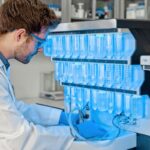
Automated synthesis systems can perform repeated stages of peptide assembly under controlled conditions.
These systems build upon the principles established by Merrifield.
Advanced Mass Spectrometry
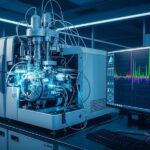
Modern instruments support detailed investigations of peptide identity, composition and chemical modifications.
Structural Biology
Techniques such as cryo-electron microscopy, nuclear magnetic resonance spectroscopy and X-ray crystallography help researchers investigate molecular structures and interactions.
Computational Modelling
Computer-based methods can assist researchers in exploring peptide conformations and potential molecular interactions.
Predictions from computational models require appropriate experimental validation.
Peptide Therapeutic Research
Some peptide-based medicines have received regulatory approval for specific medical indications.
Other peptides remain investigational and require further preclinical and clinical research.
A molecule’s biological activity in laboratory experiments does not, by itself, establish clinical safety or effectiveness.
Timeline: Major Milestones in Peptide Research
| Year | Scientific milestone |
|---|---|
| 1806 | Asparagine is isolated, marking an early milestone in amino acid chemistry |
| 1901 | Emil Fischer and Ernest Fourneau report the synthesis of glycylglycine |
| 1921–1922 | Insulin is discovered and introduced into clinical treatment |
| 1953 | Vincent du Vigneaud’s group synthesises oxytocin |
| 1955 | Frederick Sanger’s work establishes the complete amino acid sequence of insulin |
| 1963 | Robert Bruce Merrifield publishes solid-phase peptide synthesis |
| 1982 | Recombinant human insulin receives US regulatory approval |
| 1984 | Merrifield receives the Nobel Prize in Chemistry |
| 1990s | Advanced mass spectrometry becomes increasingly important in peptide analysis |
| 2000s–present | Automated synthesis, structural biology and computational methods expand peptide research |
Why Is the History of Peptide Research Important?
Understanding the history of peptide research helps explain how modern scientific methods developed.
Early discoveries established the chemical foundations of peptide science.
Later advances made it possible to determine amino acid sequences, synthesise defined peptides and investigate their molecular properties.
Today, these technologies support research across numerous disciplines, including:
- Biochemistry
- Molecular biology
- Structural biology
- Analytical chemistry
- Biotechnology
- Pharmaceutical research
The history of peptide science also illustrates the importance of careful experimentation, analytical validation and scientific collaboration.
Frequently Asked Questions
Who discovered peptides?
Peptide chemistry developed through the work of multiple scientists. Emil Fischer was particularly influential in establishing early peptide synthesis and understanding peptide linkages.
When did peptide research begin?
Its foundations can be traced to early nineteenth-century amino acid chemistry, with major advances in peptide synthesis emerging around the beginning of the twentieth century.
Who invented solid-phase peptide synthesis?
Robert Bruce Merrifield developed solid-phase peptide synthesis and published the method in 1963.
What was the first synthetic peptide hormone?
Oxytocin is widely recognised as the first peptide hormone to be chemically synthesised, through work led by Vincent du Vigneaud in 1953.
Why was insulin important to peptide research?
Insulin research contributed to understanding peptide hormone function, amino acid sequencing and the development of biotechnology.
How has peptide manufacturing changed over time?
Peptide manufacturing has progressed from laborious solution-based chemical synthesis to solid-phase methods, automated systems and specialised biotechnology techniques.
Are all peptides used in modern research approved medicines?
No. Some peptides are components of authorised medicines, while many others are studied only in experimental research settings.
Conclusion: The Evolution of Peptide Science
The history of peptide research is a story of scientific discovery, innovation and technological progress.
From the first identification of amino acids to the synthesis of peptide hormones and the development of modern analytical instruments, each major breakthrough has expanded our understanding of molecular biology.
Scientists such as Emil Fischer, Frederick Sanger, Vincent du Vigneaud and Robert Bruce Merrifield helped establish the foundations of modern peptide chemistry.
Today, peptide research continues to evolve through advances in synthesis, structural analysis, biotechnology and molecular modelling.
At Peptides UK, our Peptide Knowledge Hub is dedicated to exploring the science behind peptides through clear, accessible and research-focused educational content.
Discover more about peptide structure, amino acid sequences, laboratory synthesis and molecular signalling in our related articles.
Research and Safety Disclaimer
This article is intended for general scientific and educational purposes only and does not constitute medical advice.
Experimental research peptides must not be assumed safe or effective for human use. Materials designated strictly for laboratory research are not approved for human consumption or clinical use. This does not imply that all peptide-based medicines are unapproved.